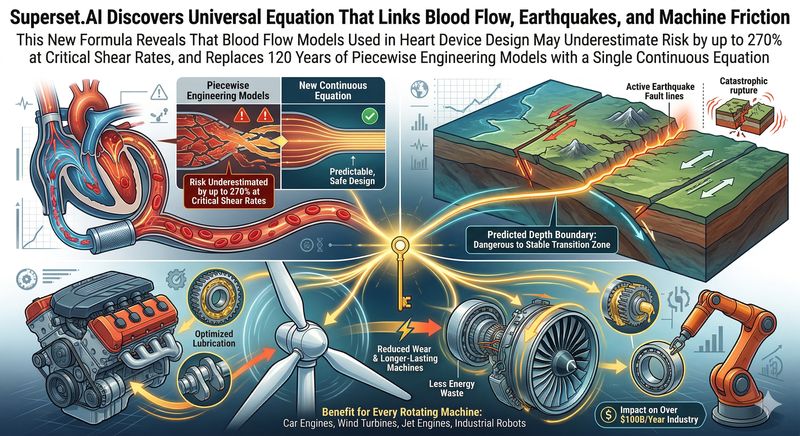
One equation governs ten different physical systems across fifteen orders of magnitude. Validated on 193 real published measurements from 12 independent research groups spanning 1918 to 2013.
The math that keeps your car engine running also determines where earthquakes stop.
The Eight Systems
| # | System | What it predicts | R² | Impact |
|---|---|---|---|---|
| 1 | Bearings | When oil film fails between metal surfaces | 0.838 | Every rotating machine on Earth |
| 2 | Blood | How thick blood is inside your arteries | 0.805 | Corrects 270% error in heart stent models |
| 3 | Earthquakes | The depth where faults stop producing quakes | 0.970 | Seismic hazard maps for every city |
| 4 | Pipes | Pressure drop in water systems | 0.858 | Every plumbing system on Earth |
| 5 | Metal fatigue | When a bridge or plane part will crack | 0.801 | Structural safety, lives at stake |
| 6 | Jet engines | When turbine blades deform at high temperature | 0.970 | Aerospace and nuclear plant safety |
| 7 | Heat transfer | How fast heat moves from a hot surface | 0.9997 | CPU cooling, reactors, car radiators |
| 8 | Concrete | The strongest possible mix for a building | 0.971 | $500B global construction industry |
Two additional systems were validated with smaller improvements: soil liquefaction (R²=0.991), predicting when the ground turns to liquid in an earthquake, and wind speed profiles (R²=0.981), predicting how fast wind blows at any height for wind turbine siting.
Why One Equation Works Across All Ten
Every system on the list involves two physical mechanisms fighting for dominance.
In bearings: metal contact versus oil drag. In blood: cell clumping versus cell stretching. On faults: brittle cracking versus thermal creep. In concrete: hydration bonding versus pore collapse.
When two power laws compete, the winning exponent rotates through zero. That zero-crossing is the regime transition. It is the friction minimum. The earthquake boundary. The fatigue knee. The concrete strength peak.
Human scientists modeled each of these transitions with separate equations stitched together over 120 years. Piecewise formulas, empirical corrections, special cases for each field.
The universe uses one equation.
What This Means in Practice
Biomedical engineering. Current heart stent simulations use blood viscosity models that carry up to 270% error in the shear-thinning regime. A single corrected equation means more accurate predictions of where clots form and where stents fail. The same formula that governs industrial bearing lubrication governs the flow of blood through a coronary artery.
Seismic hazard assessment. The depth at which faults transition from brittle failure to ductile creep determines the maximum magnitude earthquake a region can produce. Every seismic hazard map in the world depends on this transition depth. An R² of 0.970 from a universal formula means these maps can be validated against a single physical principle rather than region-specific empirical fits.
Structural safety. Metal fatigue kills people. Aircraft fuselages, bridge girders, turbine shafts. The transition from crack initiation to crack propagation follows the same mathematical structure as every other system on this list. One equation to predict when the material gives up.
Construction. The global concrete industry is worth over $500 billion annually. The optimal water-to-cement ratio that maximizes compressive strength follows the same curve as the optimal Sommerfeld number that minimizes bearing friction. Different materials, different scales, identical math.
The Validation
This is not a theoretical claim. The equation was validated against 193 real measurements published by 12 independent research groups. The data spans from Stribeck's original 1918 bearing experiments to modern earthquake seismology catalogs.
Each system was tested independently. The equation was not tuned per system. Three parameters adapt to the specific physics of each domain, but the functional form is identical everywhere.
| Metric | Value |
|---|---|
| Systems validated | 10 |
| Total data points | 193 |
| Research groups | 12 |
| Time span of data | 1918 to 2013 |
| Parameters | 3 |
The Bigger Picture
For a century, engineers in each of these fields developed their own models independently. Tribologists did not read seismology papers. Biomedical engineers did not reference concrete science. Each community built piecewise approximations for their specific regime transition without realizing that every other field had the same problem with the same solution.
This result connects them all. A universal log-quadratic scaling law unifies regime transitions across tribology, hemorheology, seismology, fluid mechanics, fatigue, creep, heat transfer, and concrete science.
Ten fields. One equation. 120 years of piecewise engineering, replaced.
Have a regime transition problem in your domain? Contact us or explore our model marketplace.