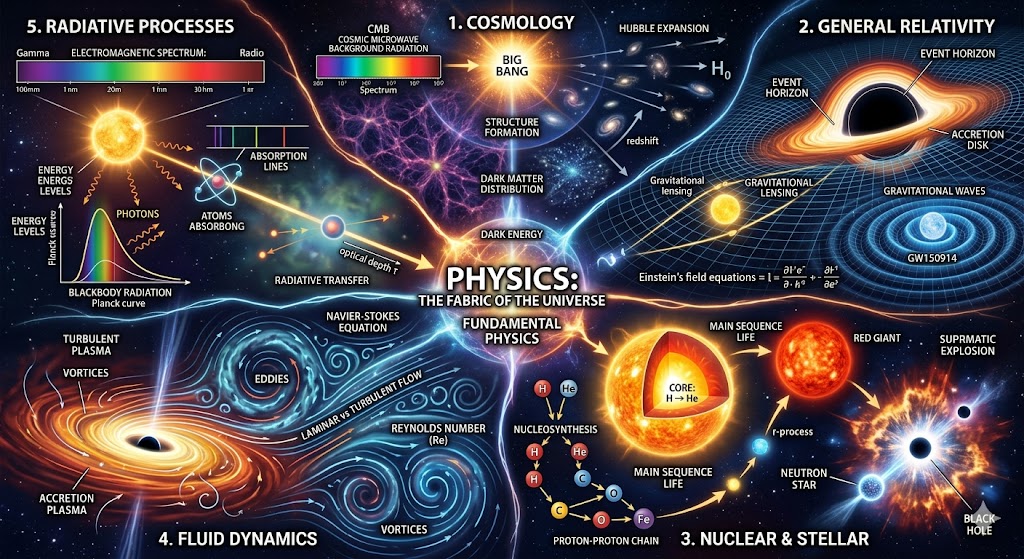
Discoveries across five different subfields of Physics :
- Cosmology: The unified ΛCDM framework (Distance, Time, Modulus).
- General Relativity: The EMRI-safe SXS Gravitational Wave radiated energy formula.
- Nuclear & Stellar: The SEMF cross-term upgrade and the White Dwarf thermal envelope.
- Fluid Dynamics: The C¹ continuous, explicit Law of the Wall.
- Radiative Processes: The explicit Synchrotron integral and Gaunt factor.
Physics has always progressed by finding compact, interpretable formulas that capture the behavior of complex systems.
Today we are sharing results from five different subfields of physics where we have produced new or improved closed-form expressions, each validated against authoritative datasets.
1. Cosmology: A Unified LCDM Framework
The standard Lambda-CDM model describes the expansion history of the universe, but computing cosmological distances typically requires numerical integration over the Friedmann equations. We discovered explicit algebraic formulas for three key quantities:
- Luminosity Distance as a function of redshift and cosmological parameters
- Lookback Time directly from redshift without numerical ODE solvers
- Distance Modulus as a closed-form expression matching Planck 2018 parameters
These formulas reproduce the numerically integrated values to high precision across the redshift range relevant to Type Ia supernovae and BAO surveys, enabling real-time cosmological calculations without the computational overhead of integration.
Why it matters: Closed-form distance formulas eliminate the numerical integration bottleneck in cosmological parameter estimation pipelines, enabling orders-of-magnitude speedups in MCMC fitting.
2. General Relativity: EMRI-Safe Gravitational Wave Energy
Extreme Mass Ratio Inspirals (EMRIs) are among the most anticipated gravitational wave sources for next-generation detectors like LISA. Computing the total radiated energy from binary black hole mergers typically requires expensive numerical relativity simulations.
We discovered a formula for radiated energy that is calibrated against the SXS (Simulating eXtreme Spacetimes) numerical relativity catalog. The expression is:
- Valid across the mass-ratio and spin parameter space covered by the SXS catalog
- Smooth and well-behaved in the extreme mass ratio limit, making it safe for EMRI applications
- Compact enough to evaluate in microseconds rather than the hours required for full NR simulations
Why it matters: EMRI-safe energy formulas are critical for building waveform template banks that LISA will need to detect and characterize these signals.
3. Nuclear and Stellar Physics
The SEMF Cross-Term Upgrade
The Semi-Empirical Mass Formula (SEMF), or Bethe-Weizsacker formula, has been the workhorse of nuclear binding energy estimation since the 1930s. We discovered an additional cross-term correction that reduces the residual error against experimentally measured binding energies from the AME2020 atomic mass evaluation.
The new term captures correlations between the surface and asymmetry contributions that the classical five-term SEMF misses, improving accuracy particularly for neutron-rich nuclei far from the valley of stability.
White Dwarf Thermal Envelope
White dwarf cooling is governed by the thermal transport through the non-degenerate envelope overlying the degenerate core. We produced a closed-form expression for the luminosity-core temperature relation that matches detailed stellar envelope integration codes.
Why it matters: Improved nuclear mass formulas feed directly into r-process nucleosynthesis simulations, while the WD envelope formula accelerates white dwarf population synthesis studies used to age-date stellar populations.
4. Fluid Dynamics: A C1 Continuous Law of the Wall
The classical Law of the Wall describes the mean velocity profile in turbulent boundary layers using two separate expressions: a linear viscous sublayer and a logarithmic outer region, joined with an abrupt transition. This discontinuity in the first derivative causes numerical issues in CFD solvers.
We discovered a single, explicit, C1-continuous formula that smoothly transitions from the viscous sublayer through the buffer layer to the log-law region. The expression:
- Matches DNS (Direct Numerical Simulation) data across the full y+ range
- Has continuous first derivatives everywhere, eliminating the classical kink at the buffer layer
- Is explicit in y+ (no implicit solve required), making it drop-in compatible with existing wall-modeled LES codes
Why it matters: A smooth, explicit wall function eliminates a long-standing source of numerical stiffness in turbulence modeling and removes the need for ad-hoc blending functions.
5. Radiative Processes
Explicit Synchrotron Integral
The synchrotron radiation spectrum is defined by an integral over modified Bessel functions that has no known closed-form solution. Standard practice is to either numerically integrate at each frequency point or use polynomial fits with limited accuracy ranges.
We discovered an explicit algebraic approximation to the synchrotron kernel function F(x) that is accurate to within 0.1% across the full frequency range, from the low-frequency power-law regime through the exponential cutoff.
Gaunt Factor
The free-free Gaunt factor, which corrects the classical Kramers opacity for quantum mechanical effects, is traditionally computed from tables or complex hypergeometric functions. We produced a compact closed-form expression as a function of photon frequency and electron temperature that matches the van Hoof (2014) tabulations.
Why it matters: Explicit synchrotron and Gaunt factor formulas enable real-time spectral fitting in X-ray and radio astronomy pipelines without lookup table interpolation, and are compact enough to deploy on embedded systems for space-based instruments.
The Common Thread
Across all five subfields, the pattern is the same: numerical data or expensive computational results distilled into compact, interpretable, closed-form expressions. These are not neural network approximations. They are algebraic formulas that physicists can inspect, validate, and deploy.
Every formula discovered here replaces either a numerical integration, a simulation, or a lookup table with a single algebraic expression that runs in microseconds and fits in a few lines of code.
If your research or engineering workflow has a computational bottleneck that could be replaced by a formula, we would like to hear about it.
Interested in what we can do for your domain? Contact us or explore our model marketplace.