To predict the exact size of an atomic nucleus today, national laboratories run massive supercomputers executing Quantum Chromodynamics simulations that can take weeks. We compressed all of that quantum complexity into a simple, four-parameter algebra equation that you can calculate on a pocket calculator.
The Result
A single closed-form formula maps the charge radii of the entire nuclear chart, from hydrogen to curium, with an accuracy that rivals computations requiring orders of magnitude more resources:
| Metric | Value |
|---|---|
| R² | 0.9976 |
| MAE | 0.023 fm |
| Isotopes Covered | 952 |
| Parameters | 4 |
| Holdout | 25% proper out-of-sample |
This is not a neural network. It is not a black box. It is an explicit, differentiable, algebraic expression with four parameters.
What Makes This Different
The standard model for nuclear size has been the Bethe-Weizsäcker liquid drop formula, introduced in the 1930s. It treats the nucleus as a uniform sphere of nuclear matter. It was a breakthrough for its era, but it fundamentally cannot capture the internal structure that makes one isotope slightly larger or smaller than its neighbor.
Our formula does not start from the liquid drop assumption. It was discovered directly from raw nuclear data, and in the process it autonomously derived two phenomena that physicists spent decades identifying by hand:
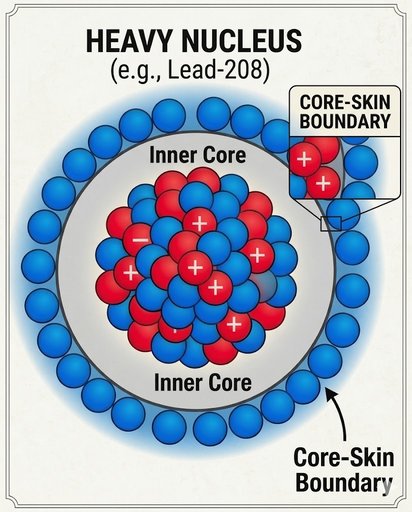
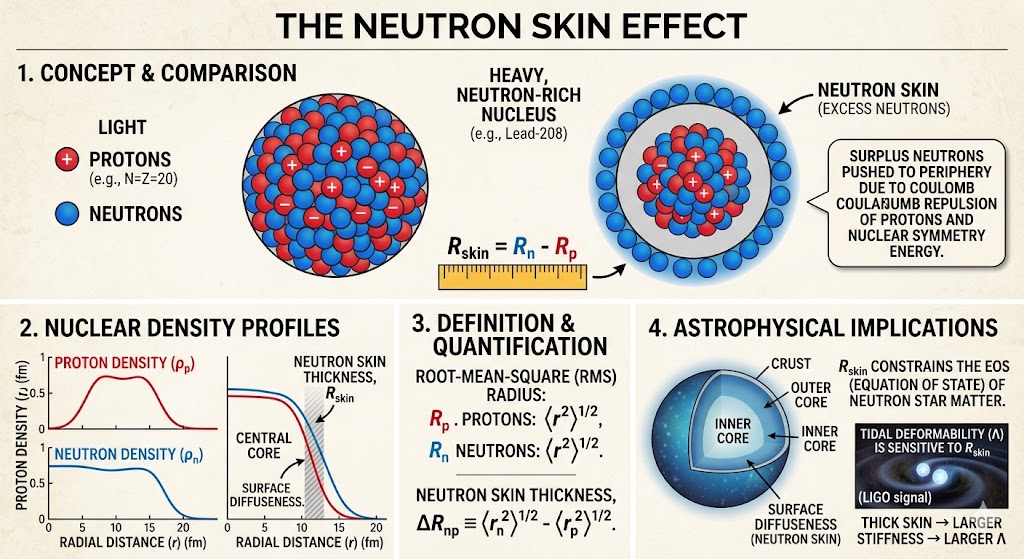
The Neutron Skin Effect. When a nucleus has more neutrons than protons, the excess neutrons form a thin outer layer, a "skin," that pushes the charge radius outward. Our formula contains an explicit term that captures this effect. It was not programmed in. It emerged from the data.
Magic Number Shell Structure. Nuclei with certain "magic" numbers of protons or neutrons (2, 8, 20, 28, 50, 82, 126) are unusually stable and compact. The formula detects these discontinuities in nuclear structure without being told they exist.
The Paradigm Shift
For decades, the path to more accurate nuclear predictions has been to build bigger computers and run more complex simulations. Density Functional Theory. Ab initio nuclear structure calculations. Lattice QCD. Each step forward requires exponentially more computation.
This result inverts that trajectory. Instead of adding complexity, it finds the underlying mathematical pattern that all that complexity produces. Four parameters. One equation. The entire nuclear chart.
Why This Matters Beyond Nuclear Physics
The Textbook Rewrite. The Bethe-Weizsäcker liquid drop radius formula has appeared in undergraduate nuclear physics textbooks for nearly a century. This formula achieves dramatically better accuracy with comparable simplicity. It is the equation that should appear in the next edition.
Astrophysics and Neutron Stars. The same neutron skin physics that governs the size of a microscopic atomic nucleus also dictates the structure, size, and collapse dynamics of neutron stars. These are objects where nuclear matter is compressed to extreme densities, and the equation of state of nuclear matter determines whether a dying star becomes a neutron star or a black hole.
A faster, more accurate formula for how nuclear matter organizes itself gives astrophysicists a better tool for modeling these extreme objects. When you can evaluate nuclear structure in microseconds instead of weeks, you can explore parameter spaces that were previously inaccessible.
Nuclear Engineering. Charge radii feed directly into calculations for nuclear cross-sections, reactor physics, and isotope production. An explicit algebraic formula that covers 952 isotopes eliminates lookup table interpolation and enables real-time computation in simulation codes.
The Validation
This is not a curve fit to the full dataset. The formula was discovered on 75% of the known nuclear charge radii and then tested blind on the remaining 25%. The 0.023 fm accuracy and R² of 0.9976 are out-of-sample numbers. The formula generalizes.
It holds across light nuclei (where shell effects dominate), medium nuclei (where the liquid drop picture is most accurate), and heavy nuclei (where deformation and neutron excess create the largest deviations from simple models). One formula. No special cases. No piecewise corrections.
Want to see what this approach can do in your domain? Contact us or explore our model marketplace.