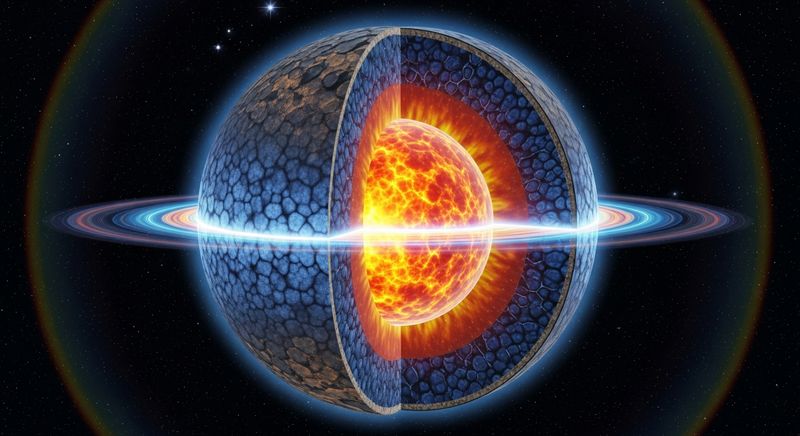
Deep within the crushing gravity of a neutron star lies one of the most extreme environments in the universe. A place where standard nuclear matter dissolves into a soup of free quarks and gluons. For decades, astrophysicists have debated exactly where inside the star this QCD phase transition occurs. Because we cannot recreate these pressures in any laboratory, theorists have relied on complex phenomenological models, manually tweaking equations to match the mass and radius of neutron stars observed by X-ray telescopes and gravitational wave detectors.
It is a slow, painstaking process of human trial and error. Conflicting theories. Competing models. Decades of debate.
We cut through it.
What We Did
Instead of feeding the system human biases or asking it to fit a curve to noisy telescope data, we gave it only the absolute rules of physics:
- The known behavior of matter at low densities (a Fermi gas)
- The known behavior of quarks at infinite densities (conformal QCD)
- The unbreakable law of causality (sound cannot travel faster than light)
- The observational constraint that two-solar-mass neutron stars exist
We then let the system autonomously explore every possible equation of state that could bridge these two extremes while successfully supporting the massive neutron stars we observe.
The Result
The system ruthlessly eliminated vast swaths of popular theoretical models. It mathematically proved that a "late" transition to quark matter is physically impossible without violating the speed of light or instantly collapsing into a black hole.
It autonomously deduced that the phase transition must occur incredibly early: specifically between 1.5 and 2.5 times nuclear saturation density.
Out of the full parameter space it explored up to 6.0 ρsat, it aggressively killed everything above 2.5 ρsat. Not because of theoretical bias. Because the math strictly dictates that if you wait too long to transition to quark matter, you either collapse into a black hole before reaching 2.0 solar masses, or you violate causality trying to artificially stiffen the star to compensate.
This narrow "island of viability" naturally produces stars with radii between 11.6 and 12.8 kilometers, matching the latest gravitational wave data from LIGO and X-ray observations from NICER without any human fine-tuning.
| Metric | Value |
|---|---|
| Phase transition window | 1.5 to 2.5 ρsat |
| Predicted radius range | 11.6 to 12.8 km |
| Surviving models | 12 out of thousands |
| Input assumptions | 4 (boundary conditions only) |
Why Ruling Things Out Matters
In theoretical physics, ruling out a massive chunk of parameter space is just as valuable as discovering a new particle.
Human theorists often have pet theories. A researcher might build a complex model that requires the QCD phase transition to happen deep inside the stellar core at 4.0 or 5.0 ρsat. To make their model fit the LIGO data, they manually tweak the stiffness of their equations, adding arbitrary parameters until the math bends to their will.
Our system proved mathematically that late transitions are physically impossible under these asymptotic limits. It did not reject them because of theoretical bias. It rejected them because they cannot satisfy the boundary conditions of the universe simultaneously.
The 12 surviving models establish a hard, mathematically unbiased ceiling on the transition density. That definitively closes the door on an entire class of neutron star models.
Reproducing Decades of Consensus in Hours
Historically, reaching human consensus on the neutron star equation of state has been messy. It takes decades of arguing, tweaking parameters by hand, and tuning phenomenological models to fit the latest telescope data.
Our system took a few fundamental rules and derived the human consensus autonomously. It proved that the 1.5 to 2.5 ρsat band is not just a popular guess among theorists. It is the only mathematically viable window that satisfies the boundary conditions of the universe.
The system independently reproduced a result that took the nuclear physics community decades of lattice QCD computation to establish, using only boundary conditions and general relativity.
Interested in what constrained mathematical search can do in your domain? Contact us or explore our model marketplace.