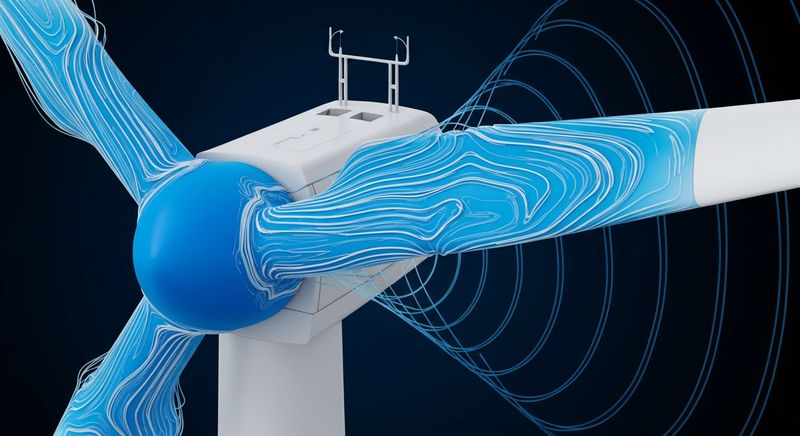
Aerodynamic noise from turbine blades is traditionally predicted using complex computational models that can take hours to run per configuration. We analyzed 1,503 NASA wind tunnel experiments and found that three terms capture the essential physics.
The Formula
The third term is the key physical insight. Noise is not just about frequency. It is not just about the boundary layer. It is about how they couple: high-frequency sound is amplified by thick boundary layers in a multiplicative way that neither variable captures alone.
The Physics Behind Each Term
When air flows over an airfoil, turbulent eddies in the boundary layer create pressure fluctuations that radiate as sound. The formula captures three distinct mechanisms:
Chord length (negative coefficient): Longer blades produce less noise per unit span. The boundary layer has more distance to stabilize, reducing trailing-edge turbulence. This is consistent with established aeroacoustic theory but is rarely expressed this simply.
Frequency + Thickness (strongest term): Higher frequencies and thicker boundary layers both reduce the standardized noise measurement. In physical terms, the dominant noise shifts to lower frequencies as the boundary layer thickens. The additive relationship means these effects are independent and stack linearly.
Frequency × Thickness (interaction term): The multiplicative coupling captures a resonance effect. Certain combinations of frequency and boundary layer state produce disproportionately different noise levels than either variable alone would predict. This interaction term is what distinguishes the formula from a naive linear model.
Why This Matters for Wind Energy
Wind turbine noise is one of the primary barriers to siting wind farms near communities. Regulations in many jurisdictions set strict decibel limits at property boundaries, and exceeding them can block or delay projects worth hundreds of millions of dollars.
Current noise prediction requires:
- Computational fluid dynamics simulations (hours per configuration)
- Empirical models like Brooks-Pope-Marcolini (dozens of parameters)
- Expensive wind tunnel testing
This 3-term formula provides instant noise estimates from basic aerodynamic measurements, enabling:
Rapid blade design optimization. Iterate on blade profiles in seconds instead of hours. A designer can evaluate thousands of chord length and operating condition combinations before committing to a single CFD run.
Siting assessments. Predict community noise impact from basic turbine specifications without running full simulations. Planning authorities and developers can screen candidate sites in minutes.
Real-time monitoring. Estimate noise output from in-situ boundary layer measurements on operating turbines. If conditions change (wind shear, turbulence intensity), the noise prediction updates instantly.
Validation
The formula was trained on 1,002 wind tunnel tests and validated on 501 holdout tests that the system never saw during training.
| Metric | Value |
|---|---|
| Training R² | 0.545 |
| Validation R² | 0.453 |
| Overfitting Gap | 0.09 |
| Data Points | 1,503 |
An R² of 0.45 on holdout data means the formula captures roughly half of the variance in aerodynamic noise from just three terms. The remaining variance comes from configuration-specific details (angle of attack, Reynolds number effects, surface roughness) that a universal 3-term formula cannot capture.
The mild overfitting gap of 0.09 confirms that the formula is learning real physics, not memorizing the training data. It generalizes.
The Data
NASA Airfoil Self-Noise Dataset, 1,503 measurements of NACA 0012 airfoils at various speeds, angles of attack, and chord lengths, conducted in NASA wind tunnel facilities. Available through the UCI Machine Learning Repository.
Have an engineering prediction problem that could benefit from a compact formula? Contact us or explore our model marketplace.